
Students rarely prepare for the SAT in only one way. They learn concepts from books or videos, take official practice tests, get help from a tutor, or take a course or use an app. Many prep services combine several of those.
When the test is just a few weeks away, every session counts. What matters is how fast your prep turns the last thing you got wrong into the next useful thing to study. A really good tutor can do that, and so can a well-built course or app. It is harder than it sounds, though: most of your practice happens on your own, between sessions, and that is exactly where the misses pile up and where nobody is looking. Books and practice tests supply pieces of it. The question is not which one is best. It is which combination has you measuring, prioritizing, learning, revisiting, and adjusting before the date arrives.
We make Study Scout, an adaptive SAT-prep platform. We built it for that gap: the hours you practice alone. We will explain where it fits, but the framework below should also help you evaluate a tutor, a course, a book, or a competing app.
The short version
With weeks left, the best SAT prep is whatever closes the feedback loop with the least wasted time: measure where you are, pick the highest-impact gap, practice it, and make sure it sticks. Study Scout is built to keep that loop moving during daily independent practice, with official Bluebook tests as the rehearsal.
Four kinds of SAT-prep support
Four ways students prepare, each with real strengths and real limits. Most students use more than one.
Self-guided instruction
Books, video lessons, strategy guides, and lesson libraries such as Khan Academy, College Panda, or Erica Meltzer's guides.
- Good for
- Learning or reviewing a concept or strategy at your own pace, for free or close to it.
- Watch out for
- It does not know what you already know. Choosing which lesson is worth doing now is still your job.
Official practice testing
College Board's full-length Bluebook tests and official questions, taken under realistic conditions.
- Good for
- A real baseline, pacing, the adaptive modules, and checking that targeted work holds up under test conditions.
- Watch out for
- A full test takes hours and gives you evidence, not learning. Someone still has to turn the results into a plan.
Human tutoring or coaching
One-to-one or small-group tutoring, or live coaching, where an instructor can teach, diagnose, plan, and hold you accountable.
- Good for
- Explanation, expert judgment, live adjustment to how you respond, and accountability. The best help for foundational gaps.
- Watch out for
- Tutors vary a lot in quality and price, and most only see the work you do together, not the practice you do on your own.
Courses and apps
Courses, boot camps, self-paced programs, and apps that combine curriculum, scheduling, diagnostics, practice, and tracking.
- Good for
- Structure and coordination, for students who do not want to build the whole plan themselves.
- Watch out for
- The category varies enormously. A fixed course gives everyone the same sequence; an adaptive platform updates as you practice. Ask what changes the plan, and how often.
A good plan usually combines several of these. For example: official Bluebook tests for realistic measurement, a book or Khan Academy for a concept that needs direct teaching, a tutor for accountability or a stubborn foundational gap, and a course or app to coordinate the daily practice in between.
Before you pay for a tutor, a course, or an app
These are the two you pay for, and the two whose differences are hardest to see from the outside. Before committing, find out:
For a tutor
- whether they review practice done between sessions and update the plan from it
- whether the plan is built on official-test results
- how much of each session goes to diagnosing versus teaching
- whether there are enough sessions before the test date
For a course or app
- what changes the plan after the first version, and how often: an initial diagnostic only, checkpoints, or every practice session
- whether it fits the test date and the study days you actually have
- whether it explains mistakes and brings missed skills back, or just assigns more questions
- whether a strong first week can cause whole topics to be skipped
"Personalized" is a word every provider uses; those four answers tell you what it means. And if there is a score guarantee, read the terms: it is a refund policy, not a method.
What matters when the test is weeks away
Efficiency is not just "personalization." It is the speed and quality of the complete feedback loop: six steps, repeated until test day. Here they are, with how Study Scout handles each one.
- MeasureEstablish the baseline
- PrioritizeChoose the best likely gain
- PracticeUse varied questions
- UnderstandDiagnose the miss
- RevisitProve it later
- ReplanChange what comes next
Measure the starting point
A recent SAT, a PSAT, an official practice test, or a week of real practice with the misses written down. Without a measurement, every plan is a syllabus read from page one.
In Study ScoutTell it your test date and target, and upload a recent SAT or PSAT score report if you have one. If you do not, the first few sessions touch every topic so your gaps show up on their own.
Prioritize likely gains
Weight by how often a skill appears and how fixable the gap is, not by weakness alone. A common skill you almost understand is a better target than a foundational topic that would take months to rebuild.
In Study ScoutOnce it knows your gaps, it spends your time on the ones most likely to move your score, and it tightens the plan as the date gets closer.
Practice the skill
Enough varied questions to show you understand the skill, not one format of it.
In Study ScoutOriginal questions, human-reviewed to match the real Digital SAT, so a skill shows up in more than one form.
Understand the miss
Name why the answer was wrong: a missing concept, a misread condition, a faulty setup, a weak strategy, a pacing decision, or a slip in execution. "Careless" is not a diagnosis.
In Study ScoutAsk about a miss and the AI tutor starts with a question about your thinking, then gives you the help you choose: a hint, a step, the concept, or the full solution.
Revisit it later
A fix counts when you can solve a different version of the problem days later.
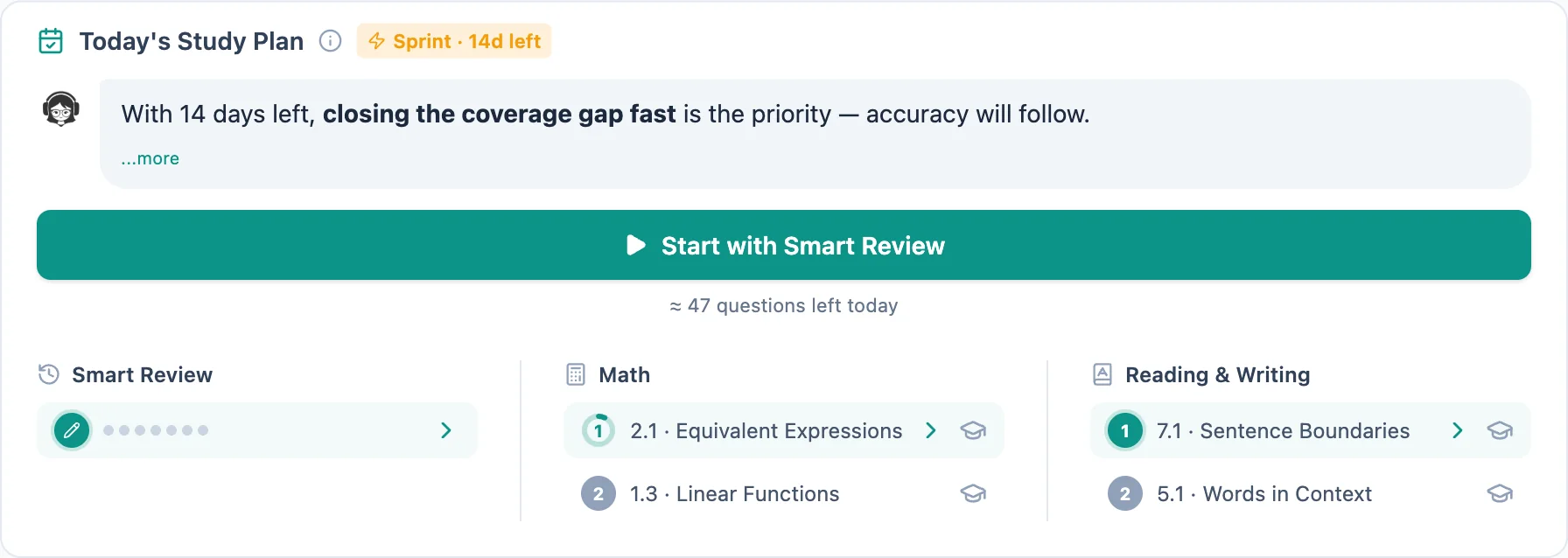
In Study ScoutMost days start with a short Smart Review: questions like the ones you recently missed.
Replan around the date
New results should change what comes next, inside the study days you actually have.
In Study ScoutEvery answer updates what comes next, and each day's work is sized to the days you have left. It also reminds you when to take an official practice test.
Prioritize short feedback loops, not finishing a syllabus. The loop does not belong to any one product. A good tutor can run it with you. A disciplined student can run it alone. A course or app can automate parts of it. Study Scout's job is to keep the whole loop moving during the hours a student practices independently, including the hours between tutoring sessions. Here is what a day of it looks like.
On practice tests. Take one official full-length Bluebook test early enough to analyze it and use the results. Take a later timed rehearsal if the first has been thoroughly reviewed and there is still time to act on the second. Do not stack tests just to collect scores. With two weeks and limited hours, one full test plus targeted timed sets usually beats several full tests with shallow review.
Who should not use Study Scout
- You already run the loop yourself. You track your misses, see the patterns, schedule review, and pick useful next work. You may not need another paid tool.
- Your real problem is sitting down to do it. A tutor, parent, coach, or live class will do more than software can.
- You have big foundational gaps and very little time. You need a skilled human teacher more than a plan.
- You are a sophomore taking the PSAT. A little free practice with Bluebook is enough. The two-week PSAT plan says so.
Sources
- College Board, Digital SAT structure (section timing and question counts): https://satsuite.collegeboard.org/sat/whats-on-the-test/structure
- College Board, Bluebook practice tests: https://satsuite.collegeboard.org/practice/practice-tests
- College Board, understanding PSAT/NMSQT scores (the SAT Suite's shared vertical score scale): https://satsuite.collegeboard.org/psat-nmsqt/scores/understanding-scores
- C2 Education, SAT prep and personalized planning (accessed 2026-09-19): https://www.c2educate.com/test-prep/sat-prep/
- Acely, adaptive SAT study plans (accessed 2026-09-19): https://acely.com/sat-prep
- Study Scout pricing: https://studyscout.ai/pricing