#18 · Two dimensions, two multipliers.
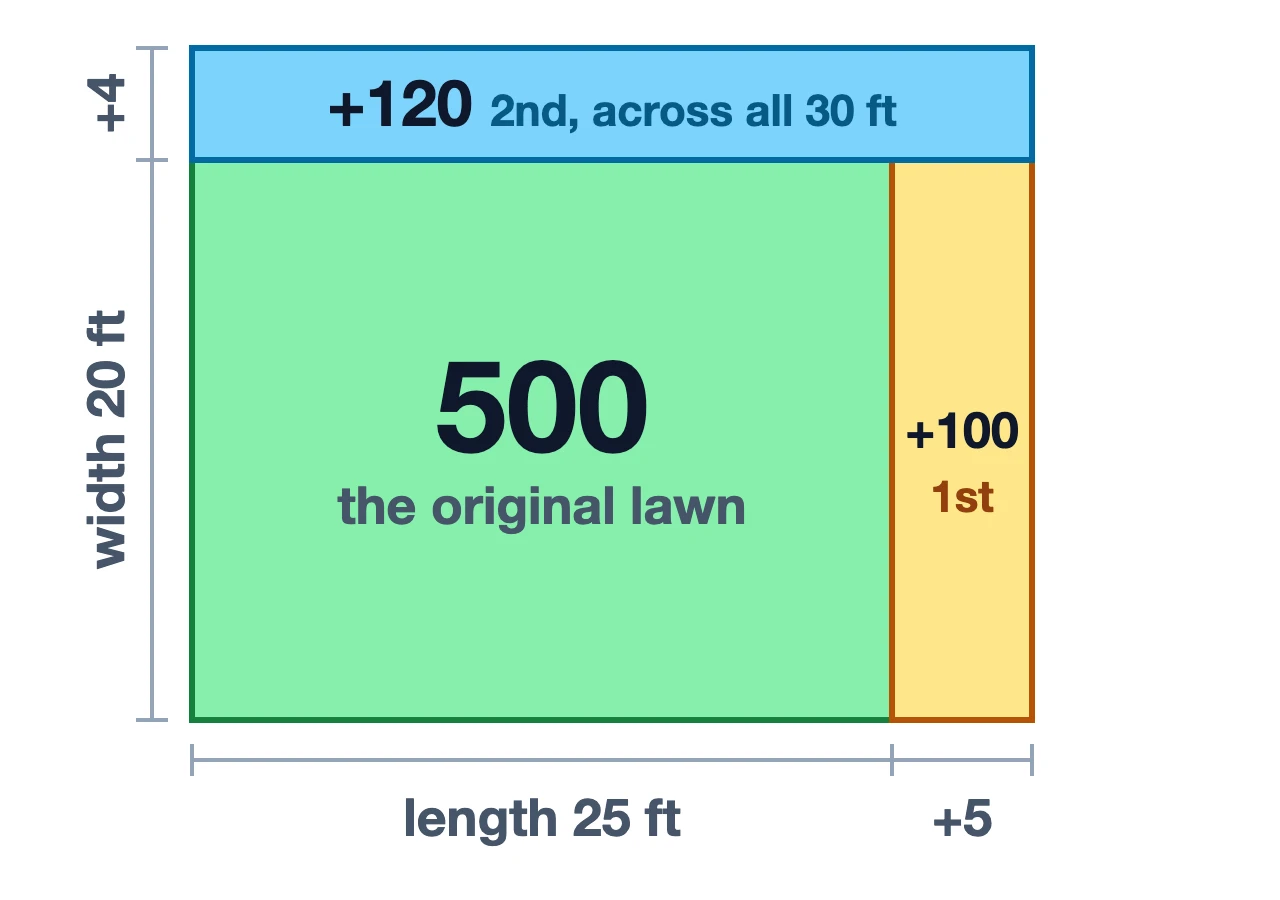
The question. A rectangular lawn has an area of 500 square feet. Its length and width each increase by 20%. What is the new area, in square feet?
The tempting guesses. 600 (20% more area) or 700 (20% + 20% = 40% more). Both are too low.
The move: one change at a time. 20% more means × 1.2. Make the lawn 20% longer and its area grows to 500 × 1.2 = 600 square feet. Now make it 20% wider and its area grows to 600 × 1.2 = 720 square feet.
The College Board's own question bank asks exactly this on a hard question: a poster whose length and width each increase by 20%.
It works for any shape
Multiply every length by a number and the area is multiplied by that number twice: sides 3 times as long give 9 times the area. And in reverse: for two similar figures, an area ratio of 9 to 1 means their matching lengths are in a ratio of 3 to 1.
The takeaway: when length and width both change, multiply once for the length and once for the width.